Tuesday, October 31, 2006

Phil Woods Celebrates his Diamond Anniversary

Why the internet is a truly wonderful thing: "WGBH 89.7FM's Jazz From Studio Four host Steve Schwartz celebrates the 75th birthday of alto saxophonist Phil Woods (born Nov. 2, 1931) with a four-hour retrospective of his ongoing career, which began more than 50 years ago. One of the true masters of the bop vocabulary, Woods has played with an impressive array of artists—touring and recording with jazz legends Thelonious Monk, Bill Evans, and Benny Goodman and playing on pop albums by Billy Joel, Carly Simon and Steely Dan."

When is this thing happening?
Friday, November 3, 8pm—Midnight (EST)

How can I hear it, I'm not in Boston?
Streaming LIVE worldwide from WGBH Studios in Boston at wgbh.org/jazz.

The picture on the left is a screen capture of Mr. Woods with David Sanborn and his band from the Night Music show. It was a great show that aired in the late 80s at an ungodly hour. The time slot and the music ensured that it was seen by no one. It featured interesting groupings (one performance had Carla Bley and Bootsy Collins) and I still have some of the videotapes I made from it. When I get the time, I’m going to upload them to YouTube. I’ll post a note when I get there.

Happy Birthday, Phil !!

Wednesday, October 25, 2006

The Elements of Jazz

A friend sent me this article a couple of days ago. The author is unknown. (If anyone knows who wrote this, let me know and I’ll add an attribution.)

The Elements of Jazz

Piano:
Pianists are intellectuals and know-it-alls. They studied theory, harmony and composition in college. Most are riddled with self-doubt. They are usually bald. They should have big hands, but often don't. They were social rejects as adolescents. They go home after the gig and play with toy soldiers. Pianists have a special love-hate relationship with singers. If you talk to the piano player during a break, he will condescend.Bass:Bassists are not terribly smart. The best bassists come to terms with their limitations by playing simple lines and rarely soloing. During the better musical moments, a bassist will pull his strings hard and grunt like an animal. Bass players are built big, with paws for hands, and they are always bent over awkwardly. If you talk to the bassist during a break, you will not be able to tell whether or not he's listening.

Drums:
Drummers are radical. Specific personalities vary, but are always extreme. A drummer might be the funniest person in the world, or the most psychotic, or the smelliest. Drummers are uneasy because of the many jokes about them, most of which stem from the fact that they aren't really musicians. Pianists are particularly successful at making drummers feel bad. Most drummers are highly excitable; when excited, they play louder. If you decide to talk to the drummer during a break, always be careful not to sneak up on him.

Saxophone:
Saxophonists think they are the most important players on stage. Consequently, they are temperamental and territorial. They know all the Coltrane and Bird licks but have their own sound, a mixture of Coltrane and Bird. They take exceptionally long solos, which reach a peak half way through and then just don't stop. They practice quietly but audibly while other people are trying to play. They are obsessed. Saxophonists sleep with their instruments, forget to shower, and are mangy. If you talk to a saxophonist during a break, you will hear a lot of excuses about his reeds.

Trumpet:
Trumpet players are image-conscious and walk with a swagger. They are often former college linebackers. Trumpet players are very attractive to women, despite the strange indentation on their lips. Many of them sing; misguided critics then compare them to either Louis Armstrong or Chet Baker depending whether they're black or white. Arrive at the session early, and you may get to witness the special trumpet game. The rules are: play as loud and as high as possible. The winner is the one who plays loudest and highest. If you talk to a trumpet player during a break, he might confess that his favorite player is Maynard Ferguson, the merciless God of loud-high trumpeting.

Guitar:
Jazz guitarists are never very happy. Deep inside they want to be rock stars, but they're old and overweight. In protest, they wear their hair long, prowl for groupies, drink a lot, and play too loud. Guitarists hate piano players because they can hit ten notes at once, but guitarists make up for it by playing as fast as they can. The more a guitarist drinks, the higher he turns his amp. Then the drummer starts to play harder, and the trumpeter dips into his loud/high arsenal. Suddenly, the saxophonist's universe crumbles, because he is no longer the most important player on stage. He packs up his horn, nicks his best reed in haste, and storms out of the room. The pianist struggles to suppress a laugh. If you talk to a guitarist during the break he'll ask intimate questions about your 14-year-old sister.

Vocals:
Vocalists are whimsical creations of the all-powerful jazz gods. They are placed in sessions to test musicians' capacity for suffering. They are not of the jazz world, but enter it surreptitiously. Example: A young woman is playing minor roles in college musical theater. One day, a misguided campus newspaper critic describes her singing as "...jazzy." Viola! A star is born! Quickly she learns "My Funny Valentine," "Summertime," and "Route 66." Her training complete, she embarks on a campaign of musical terrorism. Musicians flee from the bandstand as she approaches. Those who must remain feel the full fury of the jazz universe. The vocalist will try to seduce you and the rest of the audience by making eye contact, acknowledging your presence, even talking to you between tunes. DO NOT FALL INTO THIS TRAP! Look away, make your distaste obvious. Otherwise the musicians will avoid you during their breaks. Incidentally, if you talk to a vocalist during a break, she will introduce you to her "manager."

Trombone:
The trombone is known for its pleading, voice-like quality. "Listen," it seems to say in the male tenor range, "Why won't anybody hire me for a gig?" Trombonists like to play fast, because their notes become indistinguishable and thus immune to criticism. Most trombonists played trumpet in their early years, then decided they didn't want to walk around with a strange indentation on their lips. Now they hate trumpet players, who somehow get all the women despite this disfigurement. Trombonists are usually tall and lean, with forlorn faces. They don't eat much. They have to be very friendly, because nobody really needs a trombonist. Talk to a trombonist during a break and he'll ask you for a gig, try to sell you insurance, or offer to mow your lawn.

Picking the Tune
Every time a tune ends, someone has to pick a new one. That's a fundamental concept that, unfortunately, runs at odds with jazz group processes. Tune selection makes a huge difference to the musicians. They love to show off on tunes that feel comfortable, and they tremble at the threat of the unknown. But to pick a tune is to invite close scrutiny: "So this is how you sound at your best. Hmm..." It's a complex issue with unpredictable outcomes. Sometimes no one wants to pick a tune, and sometimes everyone wants to pick a tune. The resulting disagreements lead to faction-building and under extreme conditions even impromptu elections. The politics of tune selection makes for some of the session's best entertainment.
Example 1: No one wants to pick a tune (previous tune ends) (silence) trumpet player: "What the f..@*? Is someone gonna to pick a tune?" (silence) trumpet player: "This s%!* is lame. I'm outta here." (Storms out of room, forgetting to pay tab). rest of band (in unison): "Yes!!!" (Band takes extended break, puts drinks on trumpet player's tab).
Example 2: Everyone wants to pick a tune, resulting in impromptu election and eventual tune selection (previous tune ends) (pianist and guitarist simultaneously): "Beautiful Love!"/"Donna Lee!" guitarist to pianist: "You just want to play your fat, stupid ten-note chords!" pianist to guitarist: "You just want to play a lot of notes really fast!" saxophonist: "'Giant Steps'." (a treacherous Coltrane tune practiced obsessively by saxophonists.) guitarist and pianist (together): "Go ahead, a$%^hole." trumpet player: "This sh^%& is lame. 'Night in Tunisia'." (a Dizzy Gillespie tune offering bounteous opportunities for loud, high playing.) saxophonist: "Sorry, forgot my earplugs, Maynard." (long, awkward silence) pianist, guitarist, saxophonist, trumpet player all turn to drummer: "Your turn, Skinhead." (drummer pauses to think of hardest possible tune; a time-tested drummer ploy to punish real musicians who play actual notes.) drummer: "Stablemates." trumpet player: F..@* this! I'm outta here." (Storms out of room. Bartender chases after him.) ("Stablemates") trombonist: "Did someone forget to turn off the CD player?"
-- Not only are these disagreements fun to watch; they create tensions that will last all through the night. (As an educated audience member, you might want to keep a flow chart diagramming the shifting alliances. You can also keep statistics on individual tune-calling. Under no circumstances, though, should you take sides or yell out song titles. Things are complicated enough already.)

Monday, October 23, 2006

Alice Coltrane

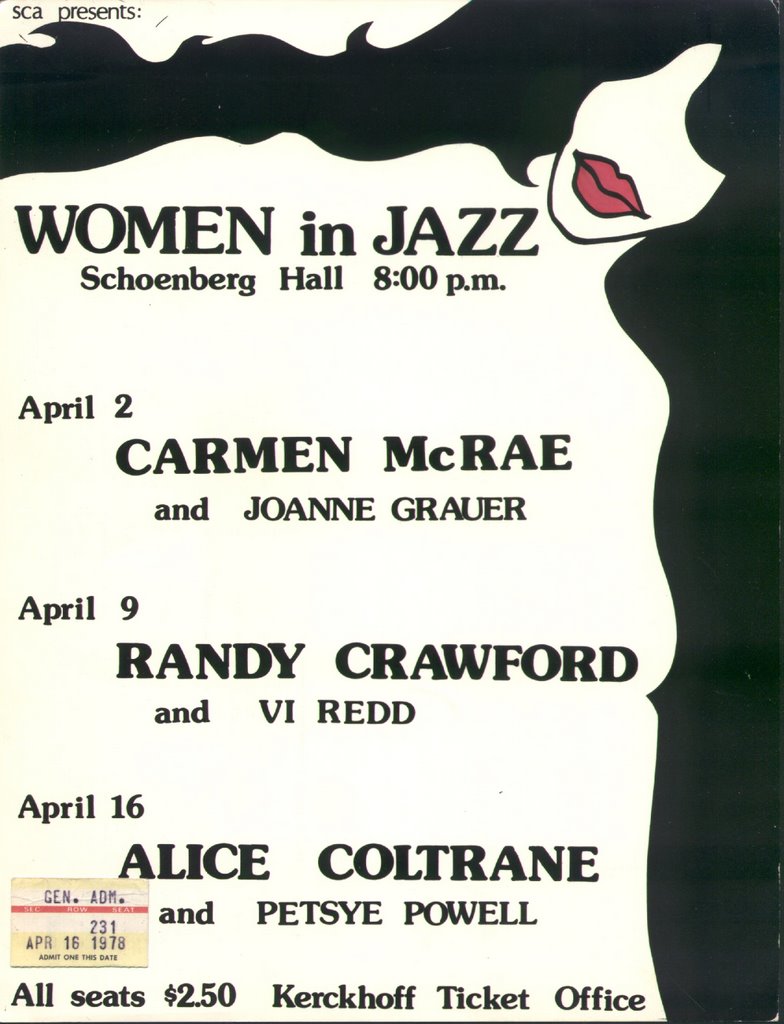
Some reminiscing in tempo: Last week, I got to be a recruiter as part of a career fair held at my alma mater, UCLA. As I was driving home, the iPod was playing Charlie Parker’s version of "Laura." The composer, David Raksin, was on the staff of the UCLA music department back when I was a student there. (I used to see him occasionally at Schoenberg Hall) This in turn reminded of a poster I recently came across from a concert at Schoenberg Hall from way back in 1978. One of the things that tell you it was ‘way back’ was the ticket price - $2.50! Now, that doesn’t even cover the fees on a ticket.


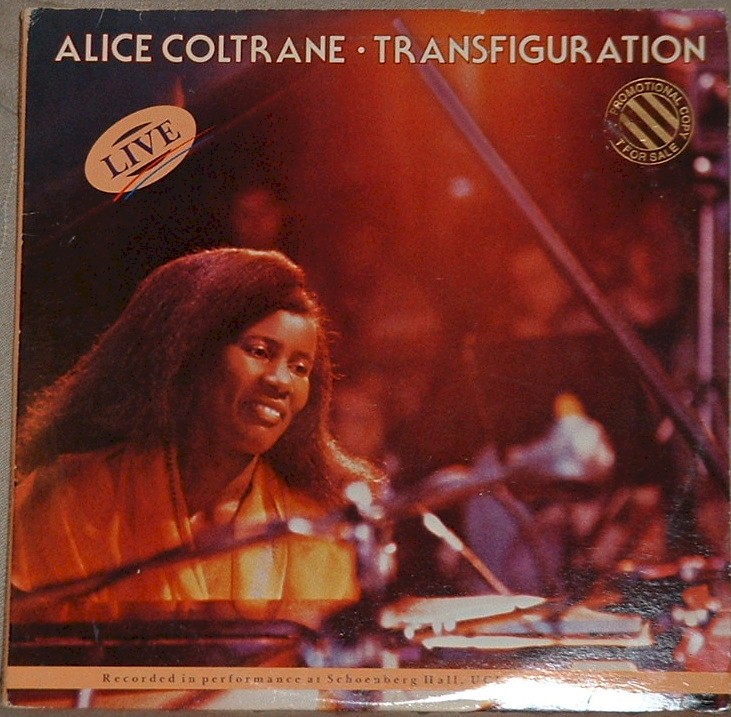
Alice Coltrane had Reggie Workman on bass and Roy Haynes on drums backing her. Quite a crew! They played some challenging stuff and it’s still that way today. How do I remember? Because this was one of the few concerts I’ve ever been to that was recorded (legally, at least) for posterity. It became a double album called "Transfiguration." She didn’t come out with another new recording for 26 years!

Sunday, October 15, 2006

Time for some new jazz stamps!!!

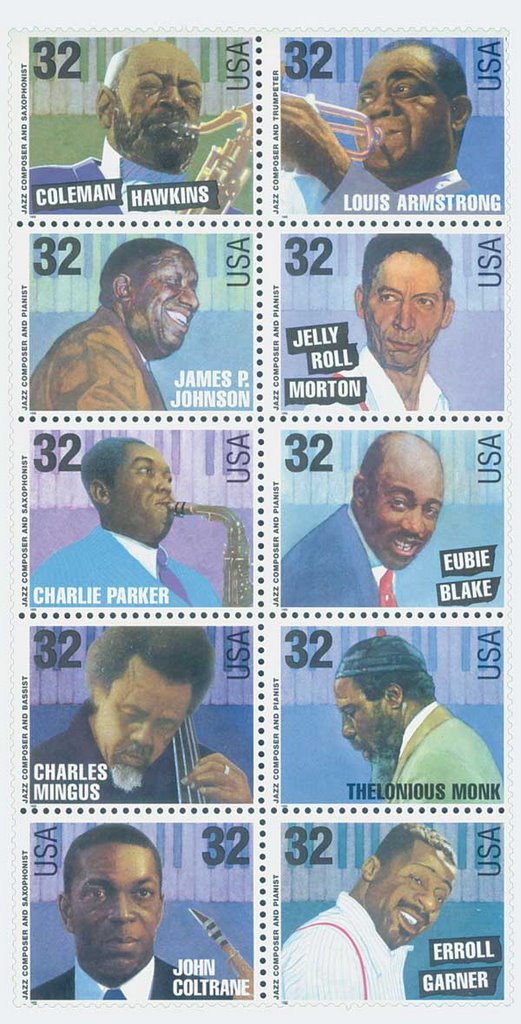
With each postage increase, the previous set of commemorative stamps becomes obsolete. It was way back in 1995 when the stamps you see at the left were released. Other honorees over the years have included Duke Ellington, Benny Goodman and Billie Holiday.

There’s criteria that an honoree must meet to grace a stamp. For one thing, unless they’re a former president, they must be dead at least ten years. Here are the complete rules. (Anyone know somebody on the selection committee?)

If I were to choose the next series, I would pick (in alphabetical order):

Sidney Bechet (1897-1959)
Bix Beiderbecke (1903-1931)
Art Blakey (1919-1990)
Miles Davis (1926-1991)
Stan Getz (1927-1991)
Dizzy Gillespie (1917-1993)
Dexter Gordon (1923-1990)
Woody Herman (1913-1987)
Earl Hines (1903-1983)
Rahsaan Roland Kirk (1935-1977)
Lee Morgan (1938-1972)
Sun Ra (1914-1993)
Lester Young (1909-1959)

Any thoughts on this out there? (How cool would a Sun Ra stamp be?)

Monday, October 09, 2006

Stephane Grappelli

One of the best features on the iPod is the shuffle function. I have almost 12,000 songs on mine, and it can lead to some interesting transitions. It can be a little jarring to go from Bessie Smith to Anthony Braxton. But still, it makes for some interesting listening.

A couple of days ago, three songs in a row by the Quintet of the Hot Club of France played sequentially. Besides guitarist Django Reinhardt (1910-1953), the group featured violinist Stephane Grappelli (1908-1997).

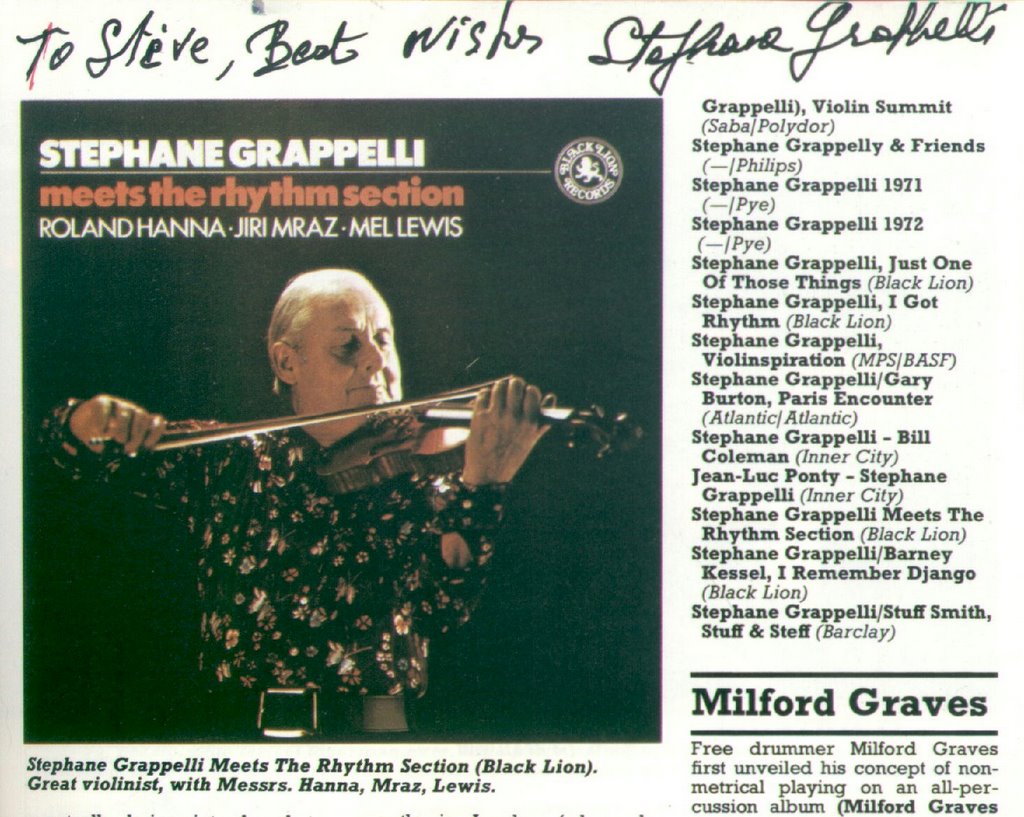
I had the pleasure of seeing Grappelli in the mid-90s at the Hollywood Bowl. I saw him taken backstage in his wheelchair before the concert. He looked extremely frail and weak and I had serious doubts that this concert would be worthwhile. I got him to sign my book (reproduced above). I even got to talk to him a little bit. His English wasn’t very good, but it was better than my French!

When it came time for his concert segment, Grappelli was walked very slowly to his seat by his nephew. The entire Bowl was silent at the sight of this man who looked like he should be in a hospital instead of center stage. He picked up his bow and started the first number. It was as if we all had been transported back 60 years! Miraculously, Grappelli had lost nothing of his technique – there were no blurred runs, no intonation problems - nothing. It was as if the music had the power to melt the years from him. I know it sounds odd, but at the start of the first number, you could hear the entire audience smile.

Monday, September 25, 2006

What's new on my 'turntable'

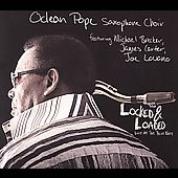
Like Saxophones? Well, Max Roach alumnus Odean Pope has a group with 9 of them teamed with a rhythm section. If that weren’t enough, he adds 3 guest tenor saxophonists – Michael Brecker, Joe Lovano and James Carter! This is great Coltrane influenced music. It’s called Locked and Loaded: Live at the Blue Note and is on the Artist label. (Ornette Coleman provides liner notes. Saxophones aplenty!)


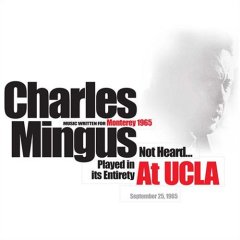
For the collectors, a classic Charles Mingus recording is released on CD for the first time. It was recorded at UCLA (my alma mater). I own the limited edition LP version that was released in the mid-80s. (I could have made a lot of money if I had sold it on eBay!). It’s called Music written for Monterey 1965, played in its entirety at UCLA. Quite a mouthful, but it’s a typical Mingus statement. One of the compositions on the album is called "Once Upon a Time, There Was a Holding Corporation Called Old America" which was later known as "The Shoes of the Fisherman’s Wife Are Some Jive-ass Slippers"!

Saturday, September 23, 2006

Happy Birthday, John Coltrane!!!!

On this date 80 years ago, John Coltrane was born. Sadly, he made just a little over half of that time. But he accomplished so much in such a short time – stints with Dizzy Gillespie, Miles Davis and Thelonious Monk before leading a quartet that redefined small group improvisation.


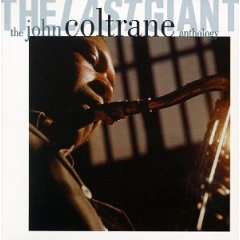
For those who are looking for a place to start listening to his music, I would recommend the 2 –disc set on Rhino appropriately entitled The Last Giant. It starts with a homemade recording as a 19 year old in the Navy and covers his development up until his Impulse! Records stint. (The Impulse! recordings can be the most daunting to the uninitiated.)


For the musicians out there:

There are 25 John Coltrane solos available at http://www.saxsolos.com/ The cool thing about this website is that you can place your order via email and they’re emailed back to you as a pdf file. Very fast! (He has a current catalog of over 800 transcriptions, ranging from Sidney Bechet to David Sanborn. He also does transcriptions by commission.)

Andrew White has transcribed EVERY John Coltrane solo ever recorded! (He also has a large library of Charlie Parker and Eric Dolphy solos available.) I’ve bought several of his transcriptions over the years. I don’t think I’ll ever be able to play Transition or Ogunde, but I had to buy them just to see what the performances looked like! I can’t remember how much his catalog costs, but you can write to him at: Andrew’s Music, 4830 South Dakota Avenue, N.E., Washington, DC 20017.

Monday, September 18, 2006

Jazz and The Simpsons


Great Simpsons episode last night!

In order to calm Bart’s antisocial tendancies, he’s given a drum set. Much to hard core jazz fan Lisa’s chagrin, Bart has a natural affinity for jazz drumming. (In an episode a few years ago, Bart thought the animation was American’s greatest art form – he didn’t count jazz "because it sucks.") But what galled Lisa the most was that Bart was given a jazz nickname ("Tick Tock" Simpson – for his steady time). To quiet her, the musicians give her the name "Downbeat" Simpson since she’s such a downer. (Personally, I think all the cool jazz nicknames are already taken.)

Lots of cool jazz references. One of my favorites was the sign outside the for the "8 hour jazz benefit – 2 songs will be played!"

Wednesday, September 13, 2006

Ornette is back !!!!


At the end of 2004, we saw the Ornette Coleman Quartet at the Walt Disney Concert Hall in downtown Los Angeles. It was one of the most memorable concerts I’ve ever seen. About the only people who didn’t think so were the blue-haired subscribers who left in droves after the first number.

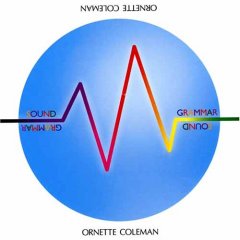
Yesterday, Ornette released a new live album called Sound Grammar with the same quartet we saw two years ago – Ornette on alto, trumpet and violin, his son Denardo on drums and two basses played by Tony Falanga and Greg Cohen. It’s his first album in ten years.

The idea of two basses apparently goes back to Duke Ellington, who started using that configuration back in the mid-1930s and used it off and on until the end of his career. But there is not that much similarity in how the two composers use this set up. Ornette uses one bass playing counter melodies, primarily arco (with bow) and the other bassist in a more tradition, pizzicato (plucked) role.

It’s great music and is another great addition to my Ornette collection. While it probably won’t get much play on the radio, I’d highly recommend it. The album comes full circle (pun intended) by featuring a new version of Turnaround, a composition he featured on his 1959 Contemporary album Tomorrow is the Question! (Hey, as a 47 year old, that wasn’t that long ago!)

Monday, September 11, 2006

9/11 - New York and Sonny Rollins


After a long absence, I’m back with another entry...

Work has been really keeping me busy lately and has also entailed more travel than usual. One of the places I got to go was New York City. It was the first time I had ever been. As a native of the Los Angeles area, I’ve tended to take all of the New York propaganda with a grain of salt, but once I was there, I can see why they feel the way they do about their city.

I was given a car tour of the city and one of the places we stopped was the hole that used to be the World Trade Center. The footprint of the area was smaller than what I would have expected. However, the height is where the center had its area. Amongst all the tall buildings nearby, it was hard to imagine them being dwarfed by what was no longer there.

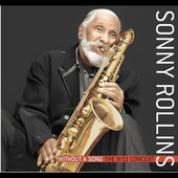
Shortly after the attacks in 2001, Sonny Rollins played a concert in New York City. It was recorded and released in 2004 as “Without A Song: The 9/11 Concert.” Great playing by one of the legends of the tenor saxophone. If you don’t have it, get it. It’ll help you put things in perspective. (As a side note, there’s some video of Sonny at www. sonny Rollins.com/birthday.php)

“The only thing we have to fear is fear itself.” – President Franklin D. Roosevelt